Ball Joint Replacement in Victorville, CA

Where can I get ball joints replaced in Victorville, CA?

A clunk from the front end over driveways, a vehicle that wanders on the freeway, or front tires wearing on the edges can all come from worn ball joints. For ball joint replacement in Victorville, CA, our D Street shop at 17033 D St measures the joint's play against the maker's limits before recommending a repair. Call (760) 241-4253.

Ball joints are a safety part, so we don't guess. We explain what we found, show you the play when we can, and give you a free written estimate. Repairs are backed by our 1-year warranty.

Ball joints are one of several parts covered by our full suspension repair service. If the clunk turns out to be a control arm bushing or a tie rod, we'll tell you.

  • Free written estimates
  • 1-year warranty on repairs
  • Brand-name OEM-grade parts
  • Cars, trucks, SUVs & luxury

What are the signs of a bad ball joint?

  • Clunking or knocking over bumps and driveways
  • Creaking or squeaking when turning the wheel
  • Steering that wanders or feels loose
  • Front tires wearing on the inner or outer edge
  • Vibration through the floor or steering wheel
  • A torn grease boot around the joint

How a ball joint works

Ball stud
A steel ball on a tapered stud that bolts into the steering knuckle. It pivots so the wheel can steer and move up and down.
Socket and bearing
Holds the ball snugly. As the bearing surface wears, play develops and you hear a clunk.
Grease boot
A rubber cover that keeps grease in and dirt out. A torn boot lets grit in, and wear speeds up.
Upper and lower joints
Many trucks and SUVs have both. Lower joints usually carry more load and wear sooner.
Pressed or bolted
Some joints press into the control arm. Others come built into the arm, so the arm is replaced as a unit.

How we check and replace ball joints

A ball joint is a pivot, like a hip joint, that lets the front wheel steer left and right while the suspension moves up and down. Every bump and every turn works the joint. Over time the bearing surface wears, the grease dries out or washes away, and the ball starts to move inside its socket. That movement is the play we measure.

Checking a ball joint properly takes more than shaking a tire. We raise the vehicle so the weight is off the joint the right way for that suspension design, then measure movement with a pry bar and, when needed, a dial indicator. Each maker publishes how much play is allowed. Some joints have a wear indicator built in. We compare what we find with those limits, so the recommendation is based on a measurement, not a hunch.

Clunks from the front end have several possible causes. Sway bar links, strut mounts, control arm bushings and tie rod ends can all make similar noises. We check each one before blaming the ball joint, so you don't pay for a part that wasn't worn.

How the joint is replaced depends on the vehicle. On many trucks, the old joint is pressed out of the control arm and a new one pressed in. On many cars, the ball joint is part of the lower control arm, and replacing the whole arm is the correct repair. That also gives you new bushings. We explain which design you have and what the estimate covers.

Replacing a ball joint changes the position of the wheel slightly, so an alignment is usually recommended afterward. Skipping it can wear out new tires quickly. We'll tell you before work starts whether your vehicle needs an alignment and where to have it done.

We usually recommend replacing ball joints in pairs on the same axle when both are worn, but not automatically. If one side is within spec, we'll say so. Greasable joints should be greased on a regular schedule, and we can show you where the fittings are.

  • Ball joint play measurement
  • Upper and lower ball joint replacement
  • Control arm with built-in joint replacement
  • Grease boot and fitting inspection
  • Front-end clunk diagnosis
  • Alignment recommendation after repair

What happens during ball joint replacement at our D Street shop?

  1. We ask when the clunk, wander or tire wear started, and whether it followed a pothole or curb hit.
  2. We lift the vehicle correctly for its suspension design and measure play in each ball joint.
  3. We check sway bar links, bushings, tie rods and strut mounts so we know the noise is the ball joint.
  4. We explain the findings and give you a free written estimate, including whether an alignment is needed.
  5. We install the approved joints or control arms and torque every fastener to specification.
  6. We road-test when safe and review the 1-year warranty with you.

Ball joint questions in the driver's own words

“My front end clunks when I pull into a driveway”

The angle of a driveway loads the suspension in a way that shows up a worn ball joint or control arm bushing. We measure both to find the source.

“My truck wanders and I'm always correcting the steering”

Play in the ball joints or tie rods lets the wheels change angle on their own. We check every steering and suspension joint, then recommend an alignment once the worn parts are fixed.

“My new tires are already wearing on the edges”

Worn ball joints can let the wheel tilt in or out under load. An alignment alone won't fix it while the joint is loose, so we check the joints first.

Frequently Asked Questions

How do I know if my ball joints are bad?

Common signs are a clunk over bumps, creaking when turning, loose or wandering steering and uneven front tire wear. The only sure test is measuring the joint's play with the vehicle properly supported.

Is it dangerous to drive with a bad ball joint?

It can be. A badly worn joint can separate and cause loss of steering control. Have any new front-end clunk inspected promptly. Stop driving if the steering suddenly feels loose.

Should ball joints be replaced in pairs?

Often, because both sides wear at a similar rate. If only one is out of spec, we'll tell you and explain your options.

Do I need an alignment after ball joint replacement?

Usually, yes. New joints change the wheel position slightly, and an alignment protects your tires.

Why replace the whole control arm instead of just the ball joint?

On many cars the ball joint is built into the arm and can't be replaced separately. A new arm also brings new bushings, which are often worn by then too.

How much does ball joint replacement cost?

It depends on the vehicle, whether the joint is pressed in or part of the control arm, and whether an alignment is needed. We give you a free written estimate after measuring.

How long do ball joints last?

It varies a lot with the vehicle, load and roads. Rough roads, towing and torn boots shorten their life. We judge them by measured play, not by mileage.

What should I tell the shop when booking?

Tell us your year, make and model, when you hear the noise, whether the steering feels different, and whether the problem started after a pothole or curb.

What other services might I need?

← Back to all auto repair services in Victorville

Serving the following High Desert Cities

Your Trusted High Desert Auto Shop

From our D Street shop in Victorville, we serve the following cities.

Ready to schedule your ball joint replacement?

Tell us what your vehicle is doing — we'll take it from there.

Johnny's Radiator and Auto Repair · 17033 D St, Victorville, CA 92395

Monday – Friday: 8:00am – 5:00pm · Saturday & Sunday: 8:00am – 3:00pm
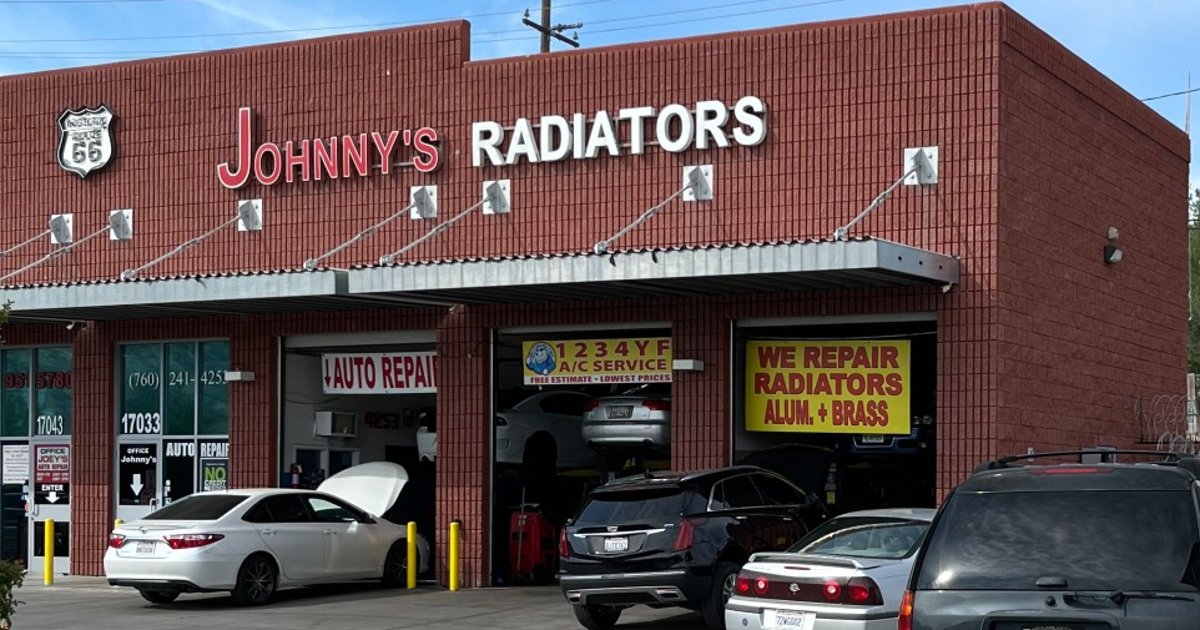
Exterior of Johnny's Radiator and Auto Repair on D Street

Two Victorville Locations

Johnny’s Auto Repair — Ridgecrest Road

General auto repair and maintenance near Spring Valley Lake

12180 Ridgecrest Rd Ste 430
Victorville, CA 92395

(760) 467-0875

Hours
Monday – Friday
8:00am – 5:00pm
Saturday
8:00am – 3:00pm
Sunday
Closed