“My steering wheel has play before the car responds”
Worn tie rod ends let the steering move a little before the wheels turn. We check each end and the inner joints with the wheels on the ground and in the air.
Tie Rod Replacement · Victorville CA
Steering that feels loose, a vehicle that wanders in its lane, or a clunk when you turn the wheel at low speed can mean worn tie rods. For tie rod replacement in Victorville, CA, our D Street shop at 17033 D St checks the inner and outer tie rods for play and recommends only what's worn. Call (760) 241-4253.
Tie rods connect your steering to the front wheels, so they directly affect how the vehicle responds. We explain what we found, give you a free written estimate and back the repair with our 1-year warranty.
Tie rods are part of the steering and suspension system covered by our suspension repair service. We check the ball joints at the same time, since the symptoms can overlap.
Worn tie rod ends let the steering move a little before the wheels turn. We check each end and the inner joints with the wheels on the ground and in the air.
Loose tie rods let the front wheels change angle on their own. Alignment and tire problems can feel similar, so we check those too.
Tie rods set the toe angle, which is how much the front of each tire points in or out. A worn tie rod lets toe change, and the tires scrub. New tie rods and an alignment fix it.
Each front wheel has two tie rod joints. Either one can wear out, and they're replaced separately.
| Outer tie rod end | Inner tie rod | |
|---|---|---|
| Where it is | At the wheel, connecting to the steering knuckle | At the steering rack, hidden under a rubber bellows boot |
| How it wears | Exposed to dirt, water and road impacts | Protected by the boot, but wears quickly once the boot tears |
| How we check it | Look for play at the ball stud with the wheel loaded and unloaded | Squeeze the boot and feel for play at the rack joint |
| Replacement | Usually simpler, with less labor | More labor, often needs a special tool |
Tie rods are the last link between your steering wheel and the front tires. When you turn the wheel, the steering rack pushes or pulls the inner tie rods, which move the outer tie rod ends, which turn the wheels. Each joint has a small ball and socket that wears over time, much like a ball joint. Once there's play, the wheel can move a little without you steering it.
We check tie rods two ways: with the vehicle raised, by moving each wheel side to side and watching for movement at the joints, and with the weight on the wheels, by having someone rock the steering wheel while we watch each joint. Some looseness only shows up one way. We also look at the rubber boots, since a torn boot lets in grit and water and the joint wears fast after that.
Steering looseness doesn't always mean tie rods. A worn steering rack mount, a loose steering column joint, worn wheel bearings or ball joints can all feel similar. We check each one so you're not paying for the wrong part. If the rack itself is leaking or worn, we'll tell you and explain the options.
Tie rods are threaded, and the length of the rod sets the toe angle of the wheel. We count turns and match the new part to the old one as closely as possible, but an alignment is still needed afterward to set the toe exactly. Skipping the alignment can wear out a set of tires in just a few thousand miles.
Lifted trucks and vehicles with bigger tires put more force through the tie rods, and they often wear faster. If you've modified your truck, mention it when you book. Heavier-duty parts may be available, and we'll go over whether they make sense for how you use the truck.
Tie rods often wear together with other front-end parts, because they all work through the same bumps and turns. When we find a loose tie rod, we look closely at the ball joints, the control arm bushings and the steering rack mounts, and tell you their condition at the same time. That way you can decide whether to handle everything in one visit with one alignment, or replace only the worn tie rod now and watch the rest. Either way, the written estimate lists each part separately so the choice is clear.
A tie rod that separates while you're driving means that wheel is no longer controlled by the steering. It's rare, but it usually happens after a long period of warning signs like looseness, clunks and uneven tire wear. Those early signs are the time to have the steering checked.
Serving the following High Desert Cities
From our D Street shop in Victorville, we serve the following cities.
Tell us what your vehicle is doing — we'll take it from there.
Johnny's Radiator and Auto Repair · 17033 D St, Victorville, CA 92395Monday – Friday: 8:00am – 5:00pm · Saturday & Sunday: 8:00am – 3:00pm
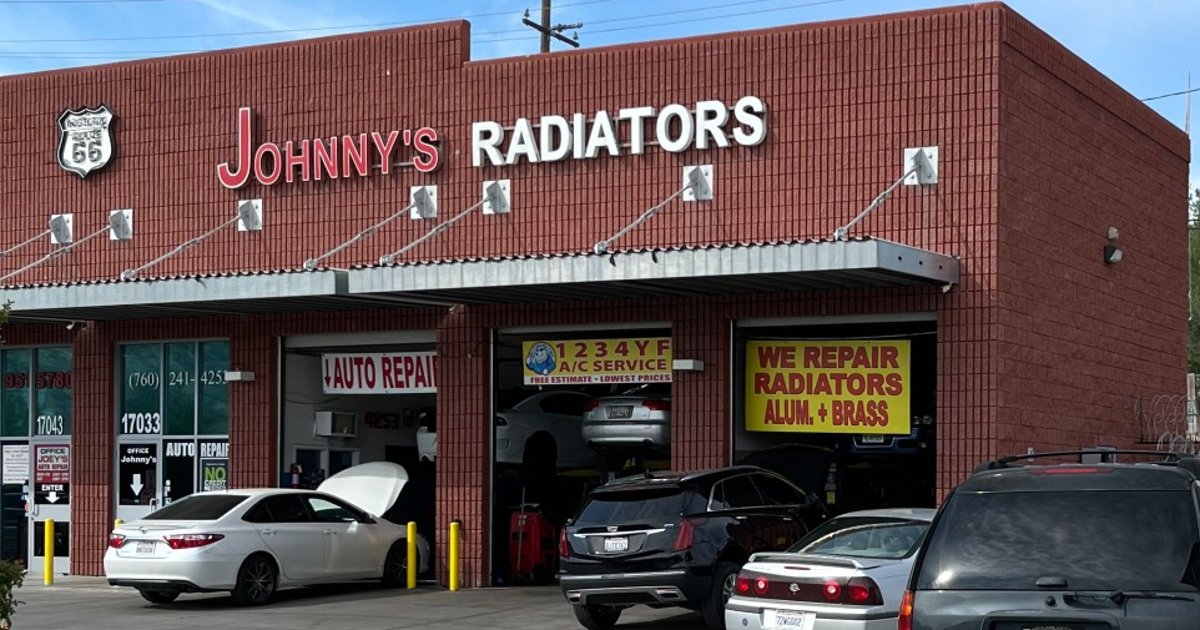
Radiators, fuel tanks and full-service auto repair
17033 D StGeneral auto repair and maintenance near Spring Valley Lake
12180 Ridgecrest Rd Ste 430